project 02
X Marketplace
Design
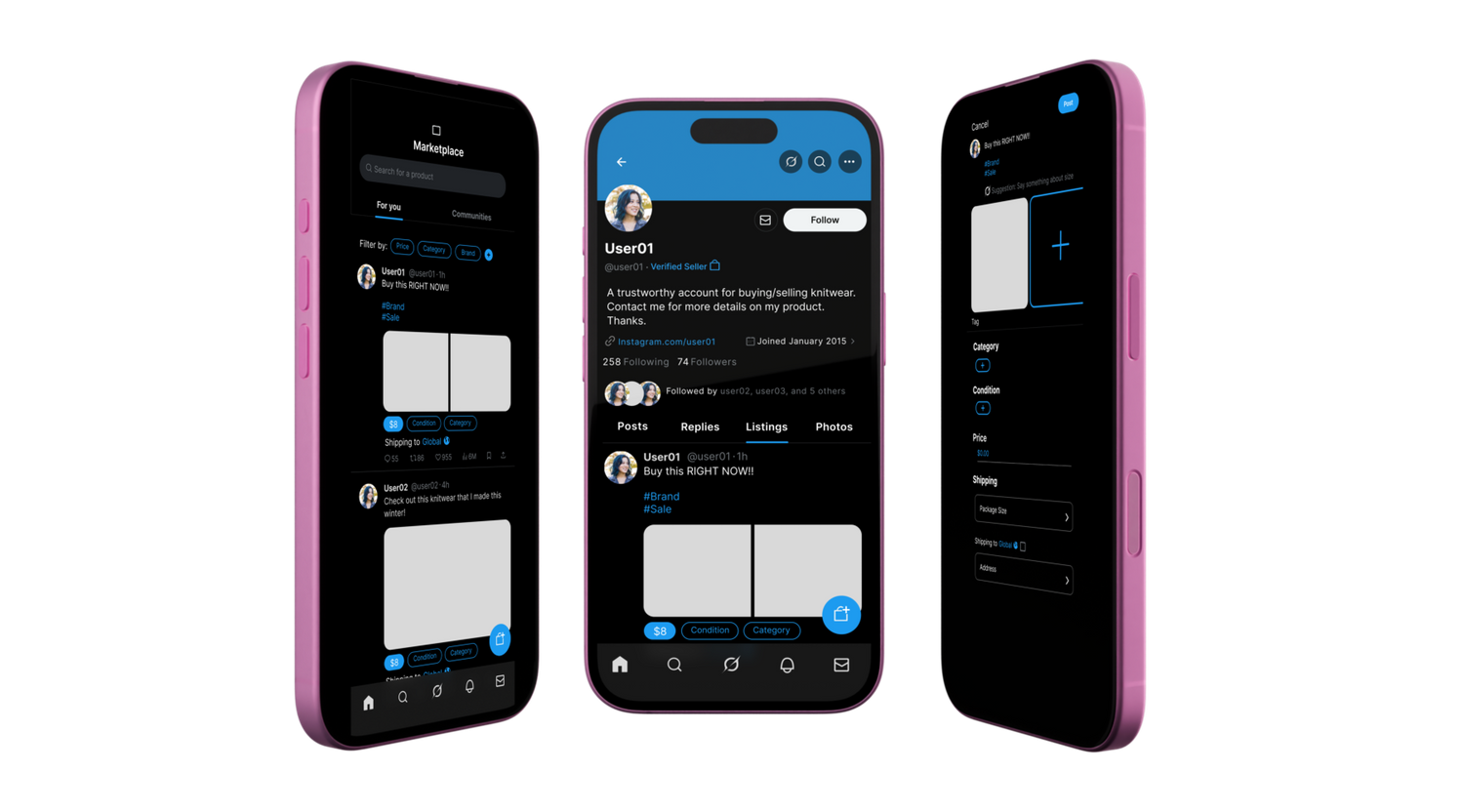
Design a marketplace experience that enables users to buy and sell creative goods, collectibles, second-hand items, and art commissions while leveraging X’s community-driven trust signals.
PrOJECT TYPE
Personal
role
UI/UX Designer
YEAR
2026
BACKGROUND

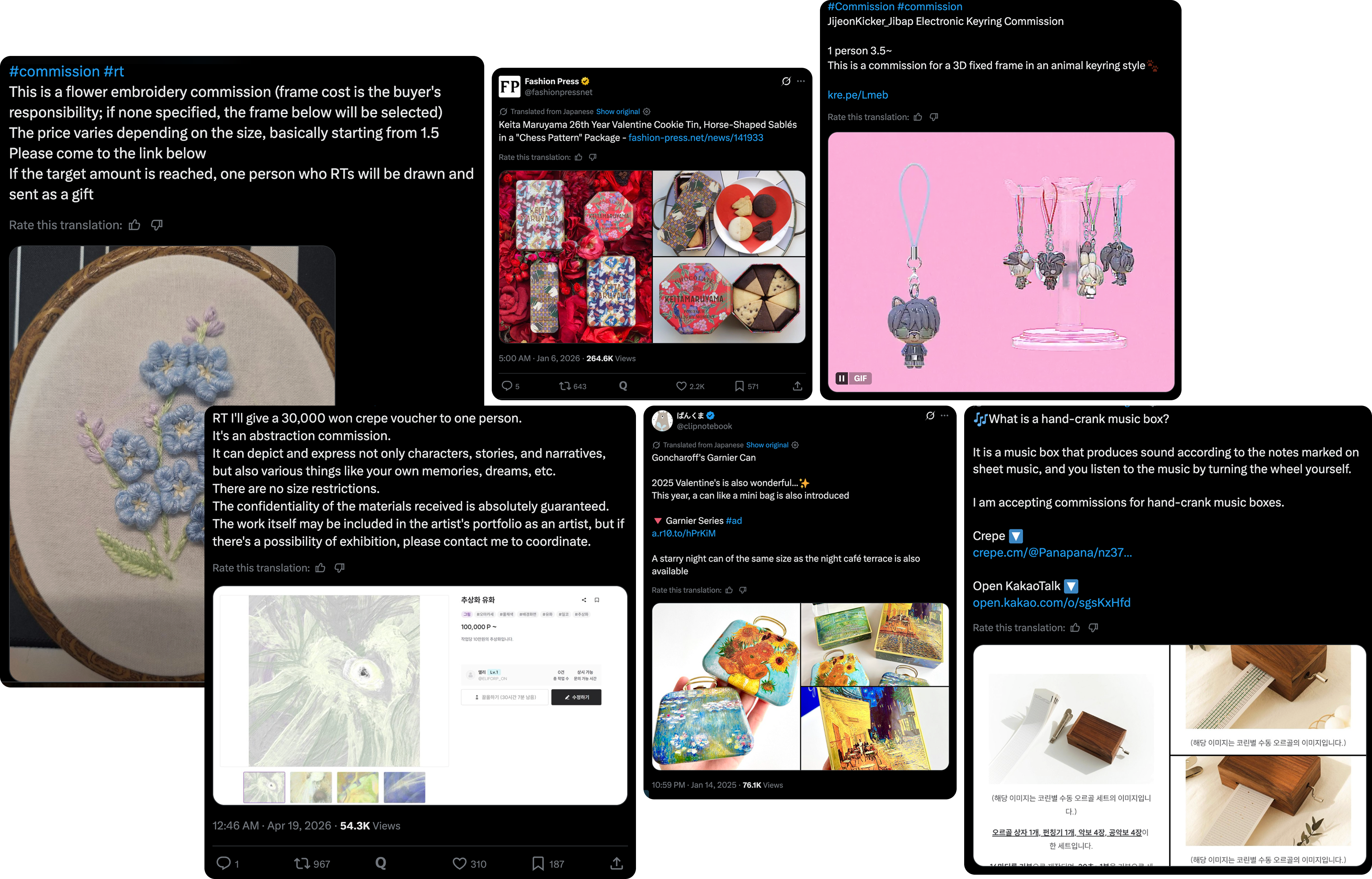
Artists, resellers, and collectors have turned X into an informal marketplace — negotiating commissions, selling prints, and trading items entirely through posts and DMs.
But without native tools for listing, payment, or trust, these transactions are scattered and improvised. X already has the community. It's missing the infrastructure.
USER INTERVIEWS
“
"Twitter is where artist-to-artist interactions thrive. Most of my profit comes from online commissions and opportunities posted by other artists.”
— Artist
“
"If I see art I like on my feed, I just DM them and ask if their commissions are open.
But 9 times out of 10, they’re not. I wish I could see all the available commissions on one page."
— Buyer
“
"As a reseller with a small following, I find it hard to make my items discoverable because my followers aren’t always looking to buy."
— Reseller
Research & Insight
PRE-RESEARCH HYPOTHESIS
I began with a hypothesis:
The barrier to transactions on X isn't demand or community, it's the lack of infrastructure to support what's already happening.
8
INTERVIEWS
with artists, resellers, and buyers
3
COMPETITIVE ANALYSIS
Etsy, eBay, and Facebook Marketplace
Competitive Analysis
X outperforms competitors in social and community features, but trails in the trust and payment infrastructure that drive buyer confidence.
This gave me a good starting point as I became aware of X’s native elements to highlight and weave into the new Marketplace feature.
COMPETITIVE ANALYSIS
X
Marketplace
Etsy
Facebook Marketplace
eBay
Social / Community Feed


Discovery by Interest


Mobile-Native Experience
Native Messaging (DMs)

Listing Structure

Seller Identity & Reputation

Buyer Protection
Payment Infrastructure

User Journey Analysis
Through 8 user journey interviews with buyers and sellers on X, I explored the pain points and solutions to each step of the user journey from both the buyer and the seller’s perspective.
SELLER'S JOURNEY
Create listing
→
Tag & categorize
→
Set pricing
→
Pick audience
→
Manage orders
→
Complete sale
!
No listing format; just a post with photos
!
No categories; relies on hashtags for discovery
!
Price negotiated ad hoc in replies and DMs
!
Targeting to specific lists/groups exists, but can’t target specifically to buyers
!
Orders scattered across DMs with no inbox
!
No transaction record or reputation system
Seller Side
No consistent format
Price, condition, and shipping vary by seller, making comparison impossible for buyers.
Discovery depends on follower count
Without categories or search, smaller sellers stay invisible.
Every sale is manual
Negotiation, payment, and shipping coordination all happen through DMs.
BUYER'S JOURNEY
Browse feed
→
View listing
→
Check seller trust
→
Purchase natively
→
Track shipment
→
Leave a review
!
Posts get buried; no way to filter for listings
!
No structured info & Price buried in captions or DMs
!
Trust inferred from follower count and replies
!
Payment via Venmo DMs — no native checkout
!
No tracking; relies entirely on follow-up DMs
!
No review system; reputation is purely informal
Buyer Side
Discovery is accidental
Buyers find listings through retweets, not intentional browsing.
Trust has no infrastructure
Without ratings or verification, follower count becomes a proxy for credibility.
Payment kills momentum
Redirecting to Venmo via DM introduces friction that loses the sale.
RESEARCH QUESTION
How might we build a native marketplace on X that adds structure for trust and discovery without losing the social dynamics that make it work?
01
Discovery needs structure
Users find sellers through retweets and community posts, but there's no native way to browse or search listings.
02
Trust must scale beyond social circles
Social reputation works within communities, but breaks down for transactions between strangers.
03
Social identity drives purchases
Buying on X is tied to community belonging and creator identity — not just product and price.
04
Demand already exists
The goal isn't to create new behavior; it's to reduce friction in a pattern that's already happening.
ITERATIONS
Wireframes
The iteration process started with wireframes featuring two different flows: listing creation (from seller side) and listing discovery. (from buyer side)
GOAL DEFINITION
Seller Flow
FEATURE 1
While refining the Seller’s user flow, I had the following two main goals in mind:
→
Listing Creation
Emphasize the ease of creating listings with a familiar social posting flow
→
Customer Targeting
Highlight how social features help get products in front of the right buyers
SELLER FLOW

1
Add product details
Upload photos and write a description

Multiple image support
Rich text descriptions
Product title

2
Tag and Categorize
Add structure to make it discoverable
Category selection
Condition tags (e.g., new, used)
Brand and model

3
Set pricing and shipping
Define the transaction details
Set your price
Shipping method & cost
Negotiable toggle

4
Choose your audience
Amplify your reach through targeted methods
Appear on the public Marketplace timeline
Reach beyond followers through Communities
Limit to people on your List for exclusive sales
✓
Your listing is live!
GOAL DEFINITION
Buyer Flow
FEATURE 2
While refining the Buyer’s user flow, I had the following two main goals in mind:
→
Listing Discovery
Buyers can find products both intentionally and organically without breaking the social experience.
→
Trust Signaling
Reduce uncertainty around purchase decisions through transparency, social proof, and community engagement.
BUYER FLOW

1
Browse the Marketplace
Multiple entry points for discovery

Marketplace tab
Following / For You feed
Communities feed
2
Filter and refine
Narrow down your search
Price range slider
Condition and category
Brand and model
3
View product details
Get all the info you need
Photos and description
Price, condition, and shipping details
Seller profile

4
Ask questions
Clarify details before you buy
Reply to listing
Public Q&A
Public community discussion
5
Buy or make an offer
Complete the transaction
Buy now button
Make an offer via DM
View contending offers
6
Continue browsing
Discover similar items
Suggested listings
Seller's other products
Community picks
final prototype
High-Fidelity Prototype
Early versions leaned heavily on X’s post format. User-testing revealed that while sellers appreciated the familiarity, buyers needed stronger signals around price, condition, and trust.
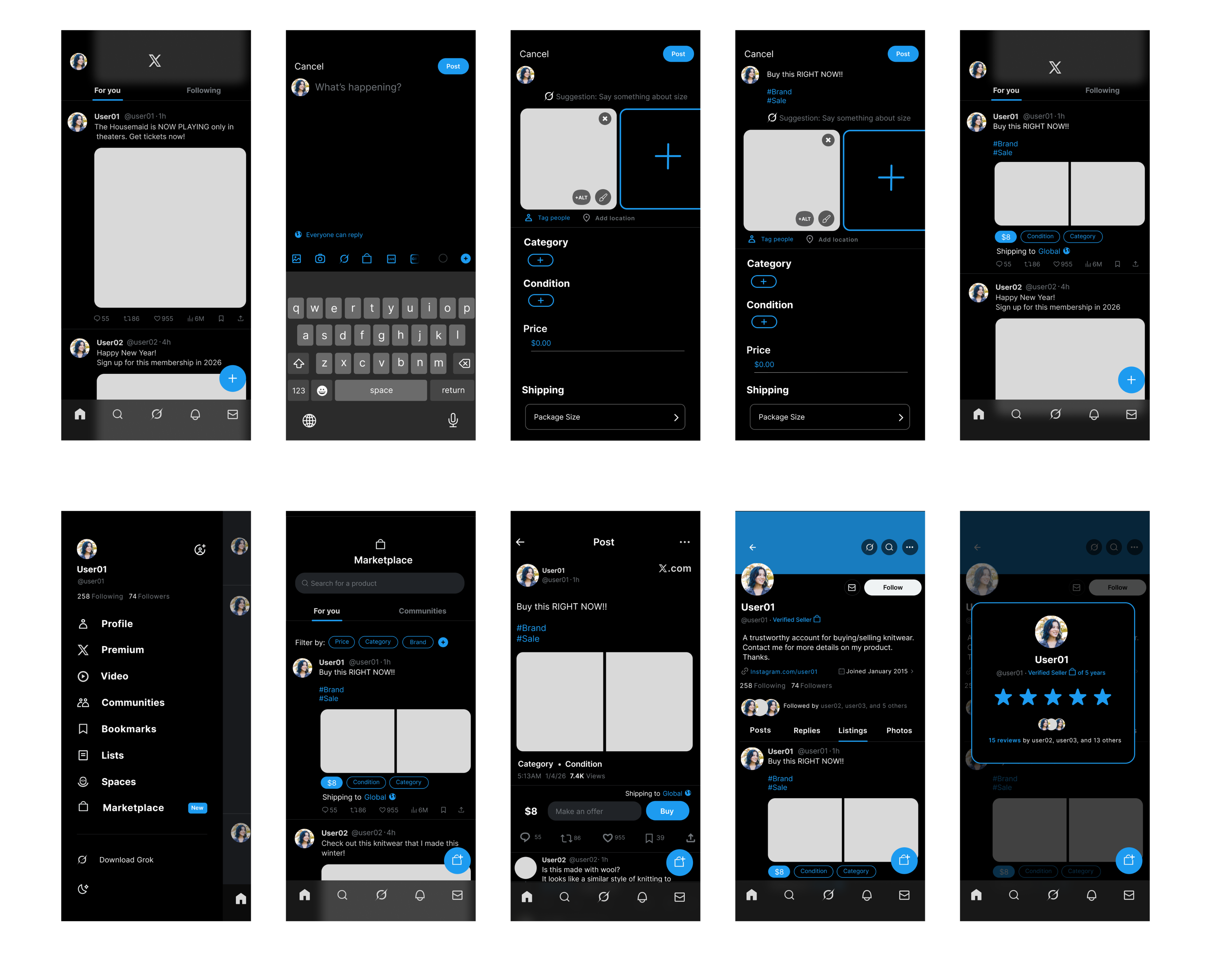
As the design evolved, the experience grew into a hybrid marketplace that still feels like X, but with structure layered in: smarter tags, clearer actions, and seller credibility signals that make transactions feel safer and more intentional.
LISTING CREATION
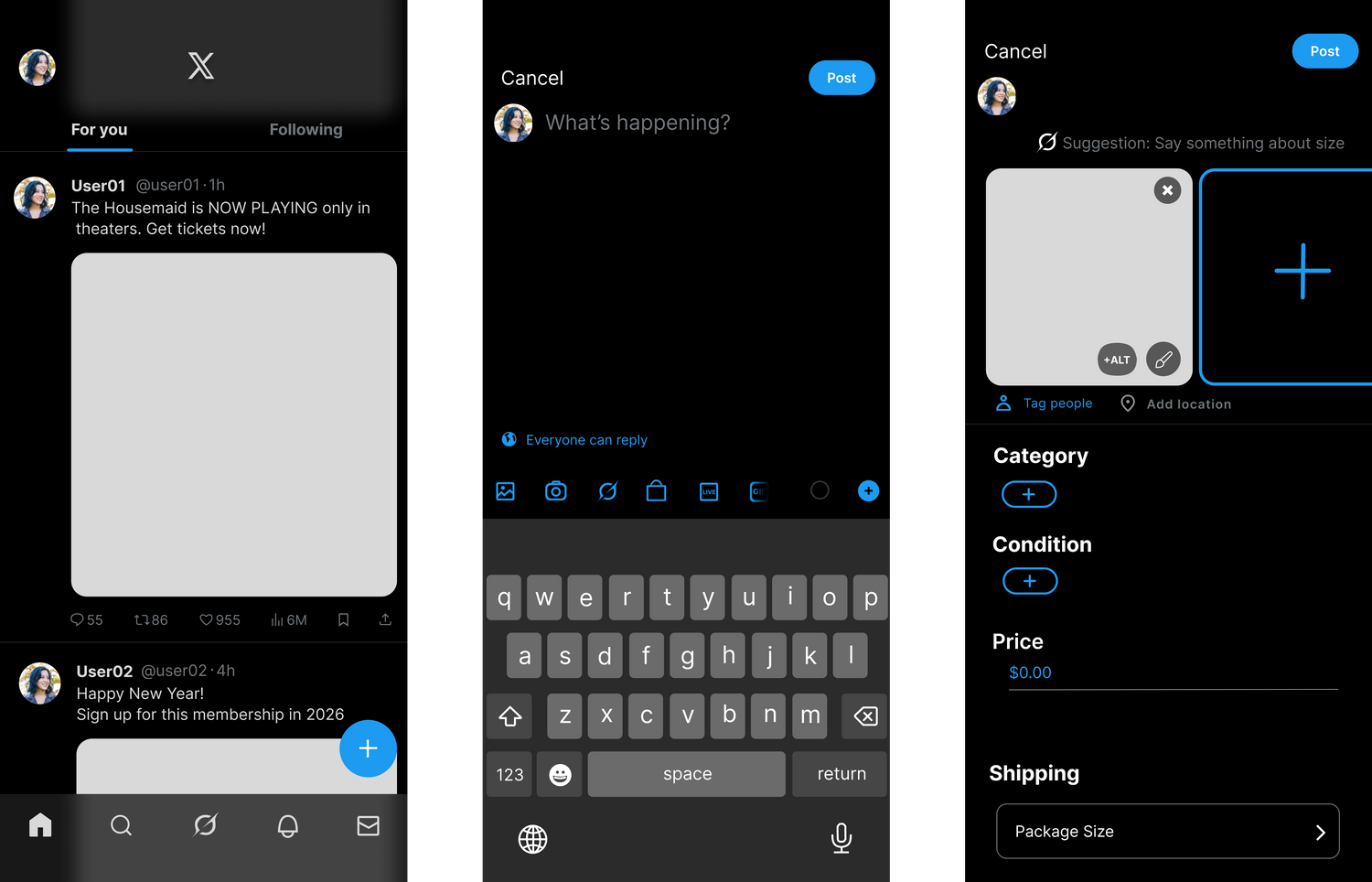
The listing composer mirrors the familiar tweet interface, reducing friction for sellers while adding structured metadata such as category, condition, price, and shipping. Micro-suggestions help guide complete and trustworthy listings
LISTING DISCOVERY
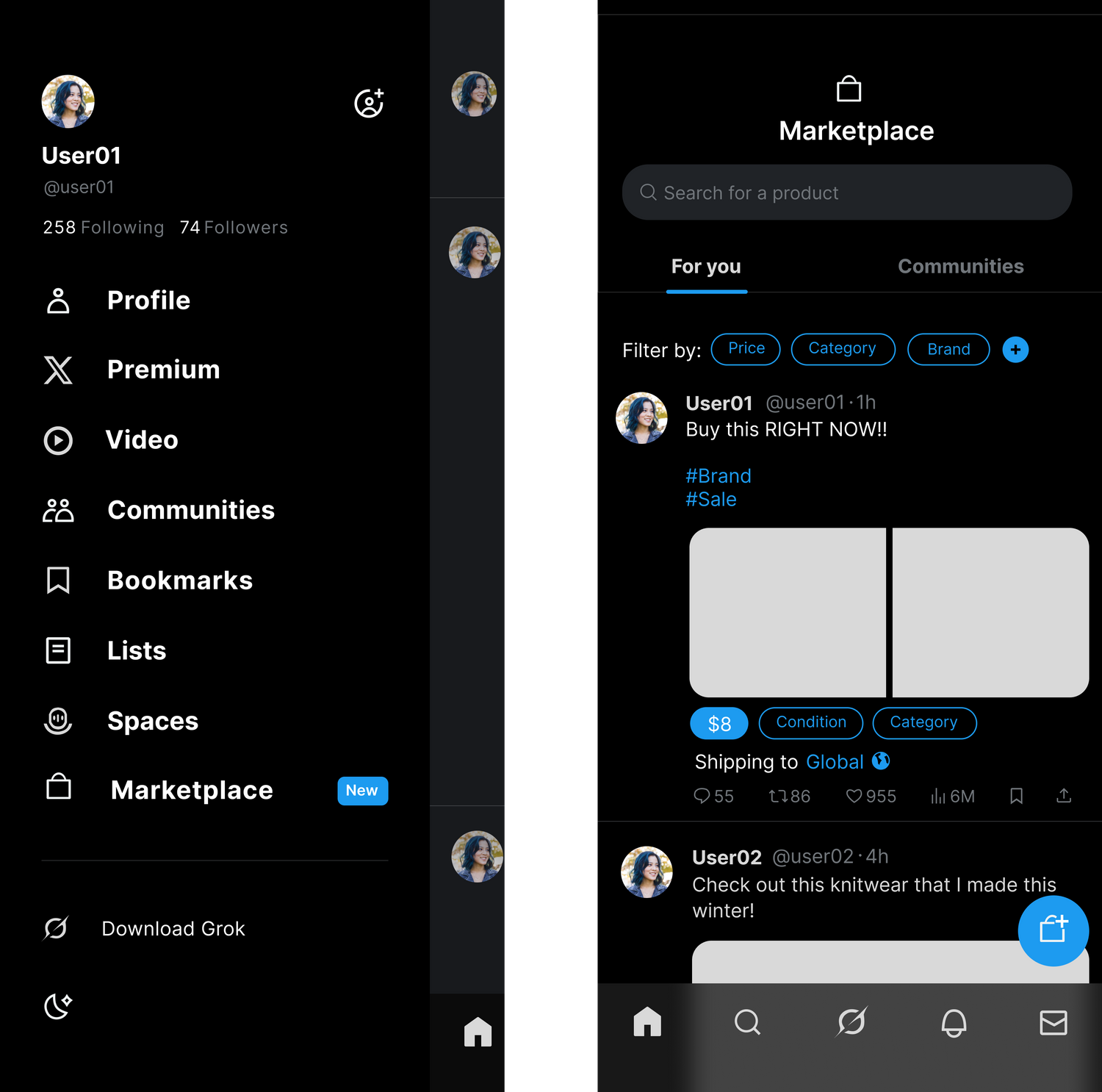
The marketplace tab combines post-style listings with structured item tags, enabling users to browse by interest or community while maintaining X’s conversational feel.
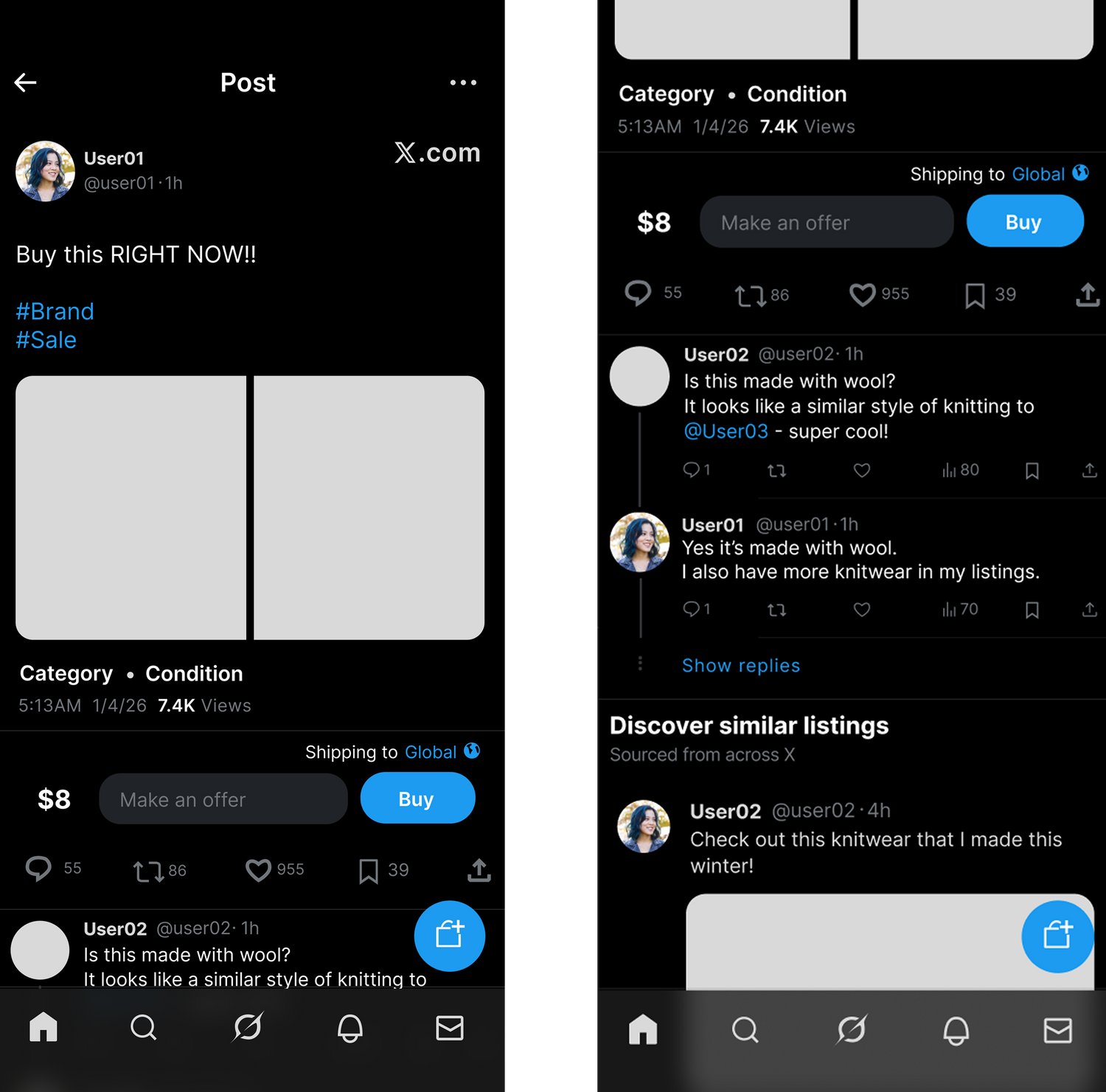
Opening a listing reveals pricing, condition, and purchase actions, while preserving native engagement UI (likes, replies, reposts). Suggested listings encourage continued browsing within the same niche.
TRUST SIGNALING
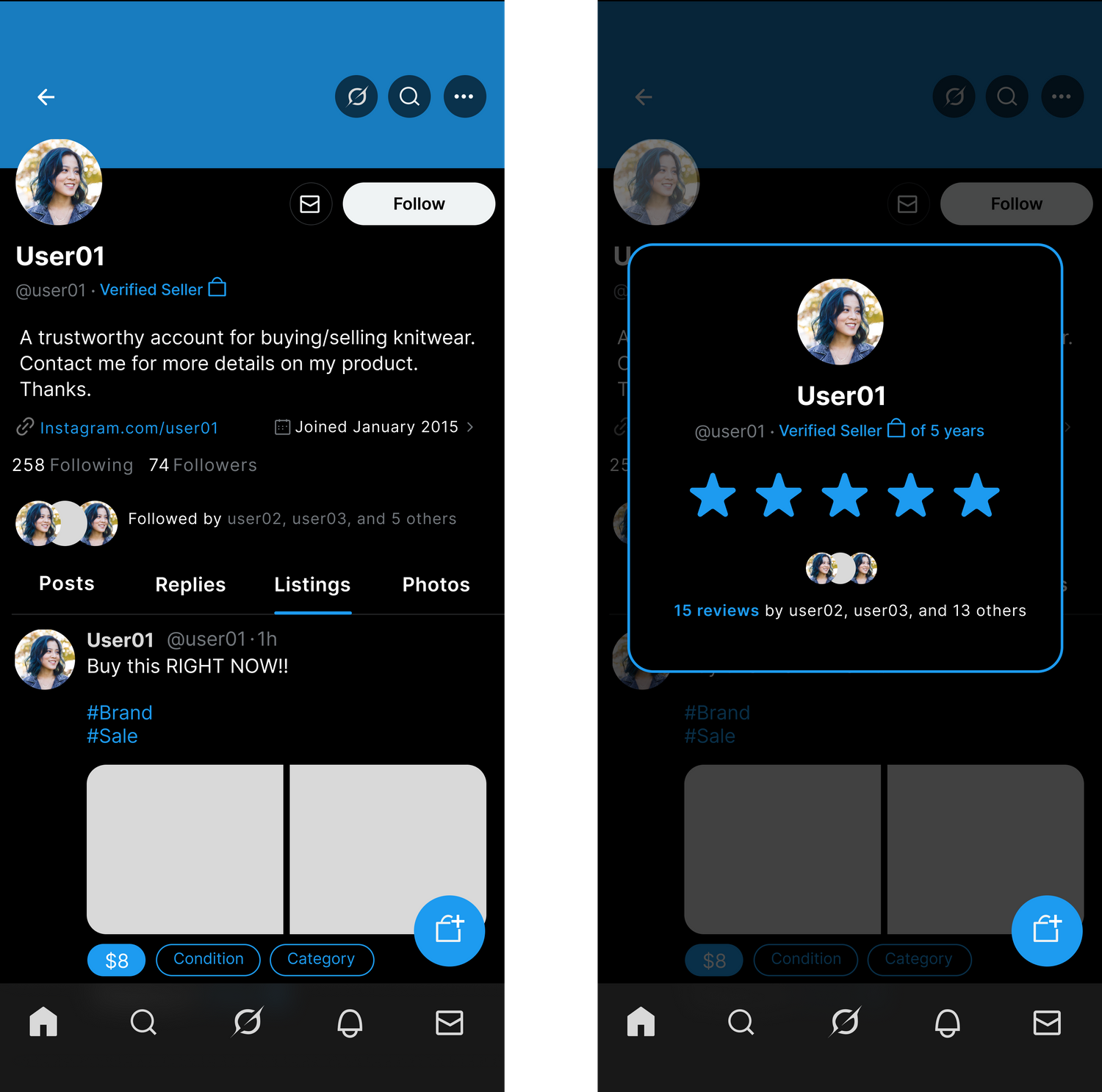
The system reinforces credibility through their verified seller status and rating & reviews by verified users.
SELLER

BUYER
PROTOTYPE IMPACT
DESIGN GOAL ACHIEVED
"Community-driven online marketplace where Sellers feel confident about reaching their audience and Buyers feel safe to make the deal."
LISTING CREATION
The listing template mirrors the familiar tweet interface, reducing friction for sellers while adding structured metadata such as category, condition, price, and shipping.
LISTING DISCOVERY
A marketplace feed of listings with structured item tags lets buyers browse by interest or community.
TRUST SIGNALING
The system reinforces credibility through verified seller status and ratings & reviews by verified users, making transactions feel safer and more intentional.
REFLECTION
TAKEAWAYS
USER INTERVIEWS
Talking with artists, collectors, and resellers highlighted how much trust, identity, and visibility matter, which led to stronger credibility signals.
EVOLUTION OF DESIGN GOAL
Through research and iteration, the project shifted from simple “posts with items” to a more intentional hybrid model that adds structure without losing what’s already happening on the platform.
LOOKING AHEAD →
Push the Marketplace even further into the Communities ecosystem and create synergy between the two features, so buying and selling feels like a natural extension of shared interests.
project 02
Design a marketplace experience that enables users to buy and sell creative goods, collectibles, second-hand items, and art commissions while leveraging X’s community-driven trust signals.
PrOJECT TYPE
Personal
role
UI/UX Designer
YEAR
2026
Artists, resellers, and collectors have turned X into an informal marketplace. People negotiate commissions, sell prints, and trade items entirely through posts and DMs. But without native tools for listing, payment, or trust, these transactions are scattered and improvised. X already has the community. It's missing the infrastructure.
USER INTERVIEWS
“
"Twitter is where there is the most artist-to-artist interaction. Most of my profit comes from online commissions and opportunities posted by other artists.”
— Artist
“
"If I see art I like on my feed, I just DM them and ask if their commissions are open.
But 9 times out of 10, they’re not. I wish I could see all the available commissions on one page."
— Buyer
“
"As a reseller with a small following, I find it hard to make my items discoverable because my followers aren’t always looking to buy."
— Reseller
PRE-RESEARCH HYPOTHESIS
I began with a hypothesis:
The barrier to transactions on X isn't demand or community, it's the lack of infrastructure to support what's already happening.
8
INTERVIEWS
with artists, resellers, and buyers
3
COMPETITIVE ANALYSIS
Etsy, eBay, and Facebook Marketplace
Competitive Analysis
X outperforms competitors in social and community features, but trails in the trust and payment infrastructure that drive buyer confidence. This gave me a good starting point as I became aware of X’s native elements to highlight and weave into the new Marketplace feature.
COMPETITIVE ANALYSIS
X
Marketplace
Etsy
Facebook Marketplace
eBay
Social / Community Feed


Discovery by Interest


Mobile-Native Experience

Native Messaging (DMs)


Listing Structure

Seller Identity & Reputation


Buyer Protection


Payment Infrastructure


User Journey Analysis
Through 8 user journey interviews with buyers and sellers on X, I explored the pain points and solutions to each step of the user journey from both the buyer and the seller’s perspective.
SELLER'S JOURNEY
Create listing
→
Tag & categorize
→
Set pricing
→
Pick audience
→
Manage orders
→
Complete sale
!
No listing format; just a post with photos
!
No categor-ies; relies on hashtags for discovery
!
Price negotiated ad hoc in replies and DMs
!
Targeting to specific lists/groups exists, but can’t target specifically to buyers
!
Orders scattered across DMs with no inbox
!
No transaction record or reputation system
Seller Side
No consistent format
Price, condition, and shipping vary by seller, making comparison impossible for buyers.
Discovery depends on follower count
Without categories or search, smaller sellers stay invisible.
Every sale is manual
Negotiation, payment, and shipping coordination all happen through DMs.
BUYER'S JOURNEY
Browse feed
→
View listing
→
Check seller trust
→
Purchase natively
→
Track shipment
→
Leave a review
!
Posts get buried; no way to filter for listings
!
No structured info & Price buried in captions or DMs
!
Trust inferred from follower count and replies
!
Payment via Venmo DMs — no native checkout
!
No tracking; relies entirely on follow-up DMs
!
No review system; reputation is purely informal
Buyer Side
Discovery is accidental
Buyers find listings through retweets, not intentional browsing.
Trust has no infrastructure
Without ratings or verification, follower count becomes a proxy for credibility.
Payment kills momentum
Redirecting to Venmo via DM introduces friction that loses the sale.
RESEARCH QUESTION
How might we build a native marketplace on X that adds structure for trust and discovery without losing the social dynamics that make it work?
01
Discovery needs structure
Users find sellers through retweets and community posts — but there's no native way to browse or search listings.
02
Trust must scale beyond social circles
Social reputation works within communities, but breaks down for transactions between strangers.
03
Social identity drives purchases
Buying on X is tied to community belonging and creator identity — not just product and price.
04
Demand already exists
The goal isn't to create new behavior — it's to reduce friction in a pattern that's already happening.
Wireframes
The iteration process started with wireframes featuring two different flows: listing creation (from seller side) and listing discovery. (from buyer side)
GOAL DEFINITION
Seller Flow
FEATURE 1
While refining the Seller’s user flow, I had the following two main goals in mind:
→
Listing Creation
Emphasize the ease of creating listings with a familiar social posting flow
→
Customer Targeting
Highlight how social features help get products in front of the right buyers
SELLER FLOW

1
Add product details
Upload photos and write a description

Multiple image support
Rich text descriptions
Product title

2
Tag and Categorize
Add structure to make it discoverable
Category selection
Condition tags (e.g., new, used)
Brand and model

3
Set pricing and shipping
Define the transaction details
Set your price
Shipping method & cost
Negotiable toggle

4
Choose your audience
Amplify your reach through targeted methods
Appear on the public Marketplace timeline
Reach beyond followers through Communities
Limit to people on your List for exclusive sales
✓
Your listing is live!
GOAL DEFINITION
Buyer Flow
FEATURE 2
While refining the Buyer’s user flow, I had the following two main goals in mind:
→
Listing Discovery
Buyers can find products both intentionally and organically without breaking the social experience.
→
Trust Signaling
Reduce uncertainty around purchase decisions through transparency, social proof, and community engagement.
BUYER FLOW

1
Browse the Marketplace
Multiple entry points for discovery

Marketplace tab
Following / For You feed
Communities feed
2
Filter and refine
Narrow down your search
Price range slider
Condition and category
Brand and model
3
View product details
Get all the info you need
Photos and description
Price, condition, and shipping details
Seller profile

4
Ask questions
Clarify details before you buy
Reply to listing
Public Q&A
Public community discussion
5
Buy or make an offer
Complete the transaction
Buy now button
Make an offer via DM
View contending offers
6
Continue browsing
Discover similar items
Suggested listings
Seller's other products
Community picks
High-Fidelity Prototype
Early versions leaned heavily on X’s post format. User-testing revealed that while sellers appreciated the familiarity, buyers needed stronger signals around price, condition, and trust.
As the design evolved, the experience grew into a hybrid marketplace that still feels like X, but with structure layered in: smarter tags, clearer actions, and seller credibility signals that make transactions feel safer and more intentional.
LISTING CREATION
The listing composer mirrors the familiar tweet interface, reducing friction for sellers while adding structured metadata such as category, condition, price, and shipping. Micro-suggestions help guide complete and trustworthy listings
LISTING DISCOVERY
The marketplace tab combines post-style listings with structured item tags, enabling users to browse by interest or community while maintaining X’s conversational feel.
Opening a listing reveals pricing, condition, and purchase actions, while preserving native engagement UI (likes, replies, reposts). Suggested listings encourage continued browsing within the same niche.
TRUST SIGNALING
The system reinforces credibility through their verified seller status and rating & reviews by verified users.
SELLER

BUYER
PROTOTYPE IMPACT
DESIGN GOAL ACHIEVED
"Community-driven online marketplace where Sellers feel confident about reaching their audience and Buyers feel safe to make the deal."
LISTING CREATION
The listing template mirrors the familiar tweet interface, reducing friction for sellers while adding structured metadata such as category, condition, price, and shipping.
LISTING DISCOVERY
A marketplace feed of listings with structured item tags lets buyers browse by interest or community.
TRUST SIGNALING
The system reinforces credibility through verified seller status and ratings & reviews by verified users, making transactions feel safer and more intentional.
TAKEAWAYS
USER INTERVIEWS
Talking with artists, collectors, and resellers highlighted how much trust, identity, and visibility matter, which led to stronger credibility signals.
EVOLUTION OF DESIGN GOAL
Through research and iteration, the project shifted from simple “posts with items” to a more intentional hybrid model that adds structure without losing what’s already happening on the platform.
LOOKING AHEAD →
Push the Marketplace even further into the Communities ecosystem and create synergy between the two features, so buying and selling feels like a natural extension of shared interests.
project 02
Design a marketplace experience that enables users to buy and sell creative goods, collectibles, second-hand items, and art commissions while leveraging X’s community-driven trust signals.
PrOJECT TYPE
Personal
role
UI/UX Designer
YEAR
2026
Artists, resellers, and collectors have turned X into an informal marketplace. People negotiate commissions, sell prints, and trade items entirely through posts and DMs. But without native tools for listing, payment, or trust, these transactions are scattered and improvised. X already has the community. It's missing the infrastructure.
USER INTERVIEWS
“
"Twitter is where there is the most artist-to-artist interaction. Most of my profit comes from online commissions and opportunities posted by other artists.”
— Artist
“
"If I see art I like on my feed, I just DM them and ask if their commissions are open. But 9 times out of 10, they’re not. I wish I could see all the available commissions on one page."
— Buyer
“
"As a reseller with a small following, I find it hard to make my items discoverable because my followers aren’t always looking to buy. I wish there was a better way to reach customers, especially in niche-interest categories."
— Reseller
PRE-RESEARCH HYPOTHESIS
I began with a hypothesis:
The barrier to transactions on X isn't demand or community, it's the lack of infrastructure to support what's already happening.
8
INTERVIEWS
with artists, resellers, and buyers
3
COMPETITIVE ANALYSIS
Etsy, eBay, and Facebook Marketplace
Competitive Analysis
X outperforms competitors in social and community features, but trails in the trust and payment infrastructure that drive buyer confidence. This gave me a good starting point as I became aware of X’s native elements to highlight and weave into the new Marketplace feature.
User Journey Analysis
Through 8 user journey interviews with buyers and sellers on X, I explored the pain points and solutions to each step of the user journey from both the buyer and the seller’s perspective.
Seller Side
No consistent format
Price, condition, and shipping vary by seller, making comparison impossible for buyers.
Discovery depends on follower count
Without categories or search, smaller sellers stay invisible.
Every sale is manual
Negotiation, payment, and shipping coordination all happen through DMs.
Buyer Side
Discovery is accidental
Buyers find listings through retweets, not intentional browsing.
Trust has no infrastructure
Without ratings or verification, follower count becomes a proxy for credibility.
Payment kills momentum
Redirecting to Venmo via DM introduces friction that loses the sale.
RESEARCH QUESTION
How might we build a native marketplace on X that adds structure for trust and discovery without losing the social dynamics that make it work?
01
Discovery needs structure
Users find sellers through retweets and community posts — but there's no native way to browse or search listings.
02
Trust must scale beyond social circles
Social reputation works within communities, but breaks down for transactions between strangers.
03
Social identity drives purchases
Buying on X is tied to community belonging and creator identity — not just product and price.
04
Demand already exists
The goal isn't to create new behavior — it's to reduce friction in a pattern that's already happening.
Wireframes
The iteration process started with wireframes featuring two different flows: listing creation (from seller side) and listing discovery. (from buyer side)
GOAL DEFINITION
Seller Flow
FEATURE 1
While refining the Seller’s user flow, I had the following two main goals in mind:
→
Listing Creation
Emphasize the ease of creating listings with a familiar social posting flow
→
Customer Targeting
Highlight how social features help get products in front of the right buyers
GOAL DEFINITION
Buyer Flow
FEATURE 2
While refining the Buyer’s user flow, I had the following two main goals in mind:
→
Listing Discovery
Buyers can find products both intentionally and organically without breaking the social experience.
→
Trust Signaling
Reduce uncertainty around purchase decisions through transparency, social proof, and community engagement.
High-Fidelity Prototype
Early versions leaned heavily on X’s post format. User-testing revealed that while sellers appreciated the familiarity, buyers needed stronger signals around price, condition, and trust.
As the design evolved, the experience grew into a hybrid marketplace that still feels like X, but with structure layered in: smarter tags, clearer actions, and seller credibility signals that make transactions feel safer and more intentional.
LISTING CREATION
The listing composer mirrors the familiar tweet interface, reducing friction for sellers while adding structured metadata such as category, condition, price, and shipping. Micro-suggestions help guide complete and trustworthy listings
LISTING DISCOVERY
The marketplace tab combines post-style listings with structured item tags, enabling users to browse by interest or community while maintaining X’s conversational feel.
Opening a listing reveals pricing, condition, and purchase actions, while preserving native engagement UI (likes, replies, reposts). Suggested listings encourage continued browsing within the same niche.
TRUST SIGNALING
The system reinforces credibility through their verified seller status and rating & reviews by verified users.
SELLER
BUYER
PROTOTYPE IMPACT
DESIGN GOAL ACHIEVED
"Community-driven online marketplace where Sellers feel confident about reaching their audience and Buyers feel safe to make the deal."
LISTING CREATION
The listing template mirrors the familiar tweet interface, reducing friction for sellers while adding structured metadata such as category, condition, price, and shipping. Suggestions help guide complete and trustworthy listings.
LISTING DISCOVERY
A marketplace feed of listings with structured item tags lets buyers browse by interest or community. Tapping a listing reveals pricing, condition, and buy/offer actions alongside native likes, replies, and reposts, with suggested listings to keep browsing within the same niche.
TRUST SIGNALING
The system reinforces credibility through verified seller status and ratings & reviews by verified users, making transactions feel safer and more intentional.
TAKEAWAYS
USER INTERVIEWS
Talking with artists, collectors, and resellers highlighted how much trust, identity, and visibility matter, which led to stronger credibility signals.
EVOLUTION OF DESIGN GOAL
Through research and iteration, the project shifted from simple “posts with items” to a more intentional hybrid model that adds structure without losing what’s already happening on the platform.
LOOKING AHEAD →
Push the Marketplace even further into the Communities ecosystem and create synergy between the two features, so buying and selling feels like a natural extension of shared interests.